
Brutalizing Brutalism
On loving a much maligned style of architecture

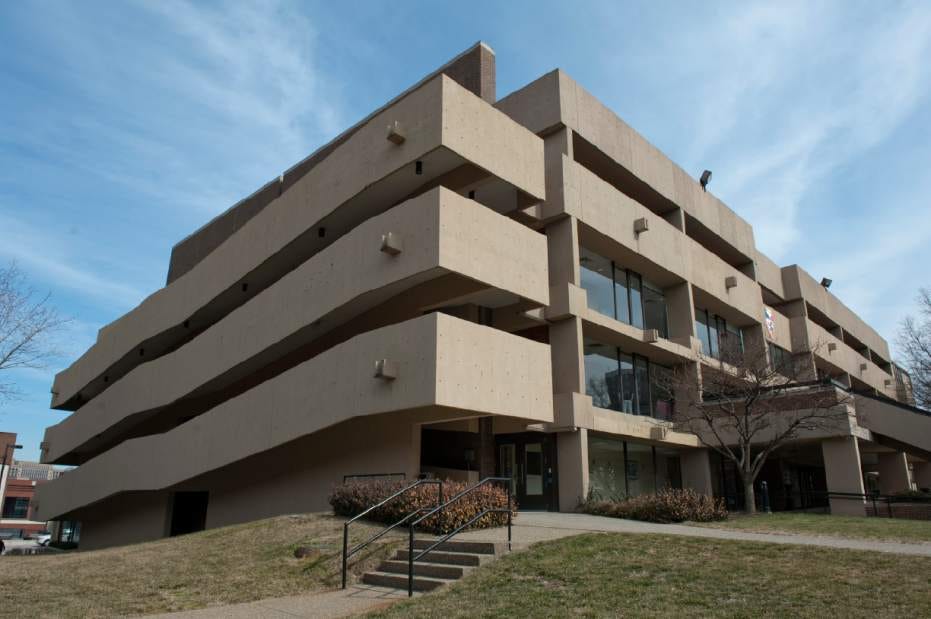
Yesterday, during my infusion1, I tried to do some internet sleuthing about the Student Union Building at Duquesne University.
In that building, around 1973, I fell in love with Brutalist architecture. I didn’t know what it was called; I just knew that a lot of academic buildings were made out of concrete, glass, and stained wood, and I loved it.
I understand Brutalism is a love-it-or-hate-it proposition. But like anything else, there are fabulous examples and fairly ordinary examples. One ordinary example is the Stonewall Jackson Memorial Hospital in Weston, West Virginia. The original part of the building has obvious Brutalist markers, but subsequent additions have tried, not completely unsuccessfully, to blend in with the concrete while simultaneously disguising it, or distracting from it.
Excellent examples are Habitat 67 in Montreal, a place where I dream of living, and the public library in Niagara Falls, New York. Unfortunately, that library is in one of many places where people love to hate brutalism. They have a gem – I hope they learn from this piece if they ever read it. (They also need to use the nooks more creatively.)
On other college campuses - The University of Illinois, Chicago. Brazosport College, Texas. Community College of Allegheny County, South and Allegheny campuses. Allegheny also includes some of the robber barron mansions from Old Allegheny City - strange combination, but still.
But the Duquesne Union. I had a work-study job in an office on the sixth floor. It was there that I learned the magical ins and outs of the building.
But the historical record of the building is as whitewashed as the building itself. Recent updates have rendered it nonbrutal, ugly, and boring.
While searching, I was, of course, directed to AI. That article informed me that the Duquesne Union was not at all Brutalist. In fact, AI said2 , it was a modernist structure designed by Ludwig Mies van der Rohe, mostly of glass, with no concrete to speak of.
Well, AI, wrong again. I wish I had a buzzer. The building designed by Ludwig Mies van der Rohe on the Duquesne campus is the Richard King Mellon Hall of Science. I admired it, too, but with less reverence. It was, after all, a glass block building 3. The concrete Union had ramps and balconies. You could stand on the sixth floor and look down to the ballroom of the fourth. People with offices on the balcony had doors to the outside – they could sneak in or out of the office without their office mates seeing them. I loved going places students usually didn’t – the faculty dining room, various offices, conference rooms, and the nooks and crannies that are typical of Brutalist architecture.
Imagine my disappoint when, on subsequent visits, I noticed changes – creeping in at first, and then overwhelming the once fabulous building with any trick in the book to hide the concrete.
One writer on Reddit described the new rear entrance as resembling the facade of a Courtyard by Marriott. That is perhaps not high praise for Courtyard design.
There was one thing we all wanted to change: the main doors to the building from College Hall and whatever was on the other side were solid wood. I was never aware of any accidents, but it was more than possible that someone leaving would severely bonk a person entering, or vice versa, because the doors swung both ways. Easy fix – change the hinges, install windows.
Instead the University wiped out the character – in fact, the life – of the most interesting building on its campus.
The Union was designed by Paul Schweikher, who arrived in Pittsburgh to teach at Carnegie Tech, now Carnegie-Mellon University. It was his first commission there. As all Brutalist buildings do, it received mixed reviews, but it had many fans like me. It was built in the early to mid-60’s. In the early 70s, Duquesne was suffering financially (perhaps concrete is more expensive than I realized). A student organization, The Third Alternative to Save Duquesne, was formed. They insisted on transparency from the administration and set out on a fund raising campaign with a goal of one million dollars. Students held phonathons and went door to door. The University emerged intact due to focused student activism.
The Third Alternative was one of the reasons I chose Duquesne. I want to be where students were involved. On this topic, too, AI misleads us: “There isn't a widely known public concept of ‘the third alternative to save Duquesne’” it says and then goes on to speculate that might have something to do with the current president becoming chancellor.
With all due respect (to President Gormley, not AI), it does not. The Duquesne homepage has the true story. That might not be creating a “widely known public concept” but it matters, at least to the University.
That is one of the reasons I grieve the loss of the Duquesne Union. It was the center of student government; the student newspaper, The Duke, student organizations and activities. When I came to it, I knew it as the place where the Third Alternative spirit might live on.
It ranks, in my memory, with the smell of my old elementary school (Richardson Romanesque), the cool rush of air from the Sewickley library (also gone after an expansion that fit in stylistically but didn’t have the insulation of the old stone portion), and the apartment where my aunt and grandmother lived in the third floor of an old Victorian mansion – the place I first discovered nooks and crannies - torn down for a church parking lot
Obviously folks at Duquesne University are not lovers of Brutalism, as I am. But to take a building that made a difference in architecture across academic campuses and that was the home to the most amazing student activism campaign I’ve ever heard of, seems more brutal than any amount of concrete.

I mention this every column so you can see that I’m staying on topic. Sort of.
Enjoy the irony. It’s what I do.
Those familiar with Tom Wolfe’s From Bauhaus to Our House will remember his clever description of a modernist city: Rohe after Mies van der Rohe of glass block buildings.